Chesham Bois House
Seasonal Interests
Spring:
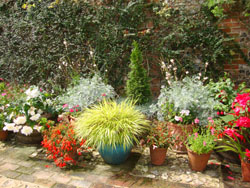 In February there is a fine display of snowdrops in the old orchard and hellebores show the garden is waking from the winter.
In March the primroses as well as the wild daffodils come out which peak in mid April.
In February there is a fine display of snowdrops in the old orchard and hellebores show the garden is waking from the winter.
In March the primroses as well as the wild daffodils come out which peak in mid April.
Hellebores dominate at this time and there are also the muscari (grape hyacinths) are lovely.
The scent of the azaleas fills the air.
A big magnolia looks spectacular in the spring but tulips can only be grown in wired pots owing to the voracious deer.
Spring into Summer:
A feeling that summer has begun is when pots of various succulents come out of the greenhouse and are mostly arranged around the summerhouse. The copper beeches with their new leaves have a lovely pinkish glow and in some years there are the very tall self-seeded 12 foot Echiums which are smothered by the bees.
In May the Cow Parsley fills the old orchard and in other areas and makes the garden a magical place for a short time.
The Gloire de Dijon rose is an early flowerer. This rose is about 160 years old as seen in an old photo but when the house had to be underpinned in 2000 it had to be removed so was stored in a large sack. Six weeks later it was replanted and to everyone’s astonishment, survived.
There is a very rare plant (now potted up) which I call Julia’s Surprise named after my mother. It is a delicate looking lychnis, was accepted by Beth Chatto’s nursery who sold it for a few years. It was a sport and does not come true from seed.
Summer:
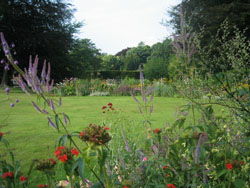 The bushy Salvias start to come out and we now grow quite a lot of them as they are very tolerant of the dry weather and continue flowering until the heavy frosts arrive.
The white Rambling Rector and the pink Pauls Himalayan Musk roses give a very good display and are the few ones we can grow as they are a delicious treat for the deer.
The herbaceous borders are at their best at this time of the year with the dieramas (Angels Fishing Rods) and blue agapanthus make a good display.
Summer into Autumn:
A lovely Indian Rain tree (Koelreuteria), a white Mulberry and a fig tree are the high lights at this time. Now the grasses have started to flower especially in the meadow providing an allee which extends the view of the rill.
Autumn into Winter:
The garden winds down in October and November although the pink nerines add a cheerful note of colour but it is still enjoyable to walk round as there is still a lot to appreciate if the frosts are late.
